
Feel alive in your creativity
Charting an inspiring path to writing, publishing, and connecting with readers

Earlier this week I woke up around 3am and couldn’t fall back to sleep. When this happens, my mind starts working and won’t shut down. To resolve it, I sometimes go into another room, and listen to a relaxing YouTube video to distract my mind enough to get back to sleep. It always works.
The other night I did this, and when I opened Youtube and the very first video in my feed said: “When Life Felt Real.” I had never seen this channel before, but I clicked the video, closed my eyes, and listened. I turns out, it was by a psychiatrist, Jeff Knuppel, and I really appreciated how deeply he explored this topic of why we get nostalgic. He had some powerful insights about how the world has changed and the imbalance that can create in each of us. For this post, I translated the entire topic through the lens we face as writers: how we navigate publishing and sharing our work.
Today, I want to explore how you can feel creatively alive. Where you sense there is potential to choose a publishing path that works for you. Where your weeks are filled with writing and connecting with readers in a manner that is deeply fulfilling.
So many writers feel distracted, overwhelmed, trapped within larger systems outside their control, and that no matter how much they do, it is never enough. I’ll explore why that is, and how to resolve it.
Let’s dig in…
Being Present with Our Creativity
In his video, Jeff reflected on the following six changes we have experienced in our lives since the 1980s, and how the each impact us in deeper ways that we may realize:
The freedom to be unreachable.
When the world stayed out of your head.
Before everything became “content.”
A world your hands could fix.
When you didn’t have to question everything.
When scarcity made things matter.
As I consider what he shared and my own experiences, I’m focusing primarily on the idea of how writers can find more creative energy to write, feel they have a clear and reasonable path to publish their work, and find that connecting with and engaging readers is fruitful and meaningful.
Some highlights from Jeff’s observations that really got me thinking:
“Being unreachable went from being the default state of a normal day, to being something you have to actively create and then defend. What a lot of people miss is being alone without that requiring an explanation.”
“Today, you wake up to notifications, texts, emails, social media, news feeds, and some are engineered to trigger an emotional reaction. And that is all before 7 or 8 in the morning.”
“There is this quiet pressure on everything to justify itself. Hobbies become a side hustle. Fitness becomes an identity. Even retirement gets turned into a project that needs to be optimized and planned.”
“The thing many miss is the experience of doing something that didn’t need to produce anything. Didn’t need to be shared. Didn’t need to be improved. It could just be what it was. Where we could be fully present with it, in the moment, and that was enough.”
This, of course, speaks to the idea that writers feel to be visible in order to grow a profile in writing communities and with readers. That sometimes it feels like we are so aware of performing our creativity to the world, that we can’t simply exist within it. Where we can socialize without considering the transaction value of it.
It made me consider being present. I saw this video recently, of an audience in lock-step with a performance by Jamiroquai in 1995. Not a phone in sight, no cameras or videocameras except the official recording:
You can watch the entire concert here if you are interested.
On the social media post I saw, this is the description: “It’s a perfect snapshot of how live music felt before the digital age: the audience wasn’t trying to capture the moment, they were living inside it, and that connection is why performances like this still hit with so much force.”
One commenter talked about the important role of the audience to the performance:
“Bands struggle to get this energy back from the crowd anymore because of cell phones, and social media. I’m guilty of it myself... I want to capture moments to post, and tag, and support my local artists and friends, and I forget that they [the band] need my energy more... they need me to participate. The audience is just as an important part of the equation as the music is, both parties need to participate to get the equation right.”
Doing Things with Purpose and Agency
Back to the points Psychiatrist Jeff made in his video, he talked about, “A world your hands could fix.” How for your car, “parts were available, and operated on mechanical logic you could learn.” That point about “mechanical logic” really struck me. It isn’t just things are more complicated now, it is that the entire base of knowledge needed to understand them are orders of magnitude different. He says of cars today:
“In a lot of cases you can’t actually fix it without proprietary tools… We have less relationship to it and authority over it. It’s not just cars, it’s everything. Your dryer. your TV, your phone, your other appliances. They are sealed, not meant to be open by you.”
“What is lost here goes deeper than convenience. [Someone] used to have a real direct relationship with the physical stuff in their life. They could understand it, maintain it, and fix it. That gave them a kind of authority over their own world. They were competent in a way that was tangible. They could solve problems with their hands and their experience. That’s all been replaced by call support and a schedule-a-service appointment. That shift doesn’t just feel inconvenient. It feels like the world has been deliberately redesigned to make us feel dependent.”
In other posts, I’ve talked about a YouTube channel I follow that is run my Mat Armstrong. Basically, he grew a massive following by fixing cars himself. He has taken on more complex projects, most recently fixing a Bugatti which the manufacturer said would be impossible for Mat to fix on his own.
Mat has been proving them wrong.
What you see in Mat’s videos are that nearly all cars have become incredibly complex. To even troubleshoot what is wrong with a BMW, you need a special computer. To start another car he repaired, every new part he replaced had to be “coded” to that individual car in its computer system, using proprietary tools.
Mat can do this because he has an incredible amount of gumption, a team around him, every tool you can buy, a big budget, and access to an incredibly knowledgable and skilled network of experts.
That said, Mat famously started fixing cars in his driveway during the day, while he worked at a restaurant in the evenings. He grew from there. That was back in 2018/2019, not really that long ago. Today, he has 7 million subscribers on YouTube, and it is estimated he is earning a few million dollars a year, all through his efforts to rebuild cars on his own. And it’s worth noting: he doesn’t often sell the cars he rebuilds, that isn’t where his revenue comes from. It is all people watching the process of him fixing cars, and how engaging he makes that process.
What I take from Mat’s example is the power of focus. On approaching your craft and your creative goals with purpose and agency. That even though the world may feel more complex, we each have the ability to chart our own path, and to come together with others in a manner that is deeply fulfilling.
The Mental Load of Navigating Publishing and Marketing
There is so much more nowadays that we must process, it can feel like a burden. To not just create, but be aware of trends, to share who you are and what you do, to know all the authors and books and influencers that are popular, to understand that myriad of ways that publishing continues to change, and to stay up with al the tech that is constantly advancing as well.
For example, many writers are telling me about the barrage of emails they are receiving where someone is offering to help them promote their books. The emails feel 100% personalized to them and their books. For the most part, these were written with AI, and the writers I know tell me about their failed efforts to actually connect with a real person on the other end. It can all be very confusing, specifically because the emails are crafted in a manner to engage you emotionally. To feel “seen” as a writer because the pitches talk so fluently about your published work. But when these writers scratch the surface, they don’t find what they hoped for.
Psychiatrist Jeff put it this way:
“There was something fundamentally different about moving through your day back then, [decades ago.] You went to a restaurant because someone you knew said it was good. You didn’t then cross reference 200 online reviews then try to figure out which ones were fake. You bought something from a store, and a transaction was a transaction. No one was harvesting your purchase data to retarget you with ads for the next 6 months.”
“These things had a basic straightforwardness to them that is hard to describe until you realize how much of it is gone.”
“Now think about what it takes to get through a day with your guard at the right level. Is this email legitimate, or is it a phishing attempt? Is this product review real, or did the company pay for it? Is this news story reporting facts, or is it just designed to provoke a reaction? Is this company going to sell my information? Is this music AI generated? Is that photo real? It’s exhausting, and it’s constant.”
“Most of us have gotten so used to it, that we don’t even recognize it as a burden anymore. It’s just the way things are. But it is a burden, with attacks on your mental energy every single day. This background process of having to audit, verify, and second guess almost everything you interact with. I think the thing most people miss is not some perfect and innocent world that never existed. Its the ability to get through a normal day without feeling like you need to be a hyper vigilant detective about everything.”
This is where it can feel logical and even ethical to spend more time researching if and how to write a newsletter, than actually writing and publishing it. Where spending six months carefully analyzing platforms, trends, case studies, and so much else — feels like a necessary part of the process.
Something I discuss with writers so often in my work is the power of preserving their creative drive. Of having a clear and cohesive plan, but also one that feels approachable and manageable.
Too Much Information and Too Many Options Can Overwhelm Writers
I’ve written a few times this year about my 2026 goal of watching 200 movies this year. Right now, I’m on movie #159, pretty close to my goal, and it’s only mid-year. Critical for me was to only use physical media instead of streaming services. So when I start the week, there is a stack of DVDs and Blu-ray disks next to my TV. This defines what I’m watching this week. It is not endless scrolling on streaming apps. I want to spend my time watching art, not sorting through hundreds of thousands of titles, on a screen trying to find just the “right one,” and getting distracted and lost in analysis paralysis.
For your journey with writing, publishing, and sharing, I imagine you have your own places where you get overwhelmed. Where things feel overly complicated, even though you have the best intentions.
Psychiatrist Jeff talked about how in previous eras, scarcity made things matter:
“Waiting for a [music] album to come out, then listening to it for months — it was an event and it mattered to me in a way that is hard to explain now. There was anticipation, scarcity, and a physical object in my hands that I paid for and owned.”
“At a certain point, having greater choices doesn’t make life better. When everything is instantly accessible, constantly available, and endlessly abundant, it’s harder to feel the full weight of any single experience.”
In the mid-1990s I remember coveting a Tangerine Dream box set that I found at a good price. It felt special and rare. The other day, I asked my 15 year old if he’s ever heard the band Tangerine Dream. As he said, “No,” he is already opening Spotify, and has instant access to everything they ever recorded for free (because we pay for a family subscription.) If he wanted to know more, he would have access to every documentary ever made about them on YouTube, interviews with members of the band, recordings of live shows, reaction and commentary videos, and so much more.
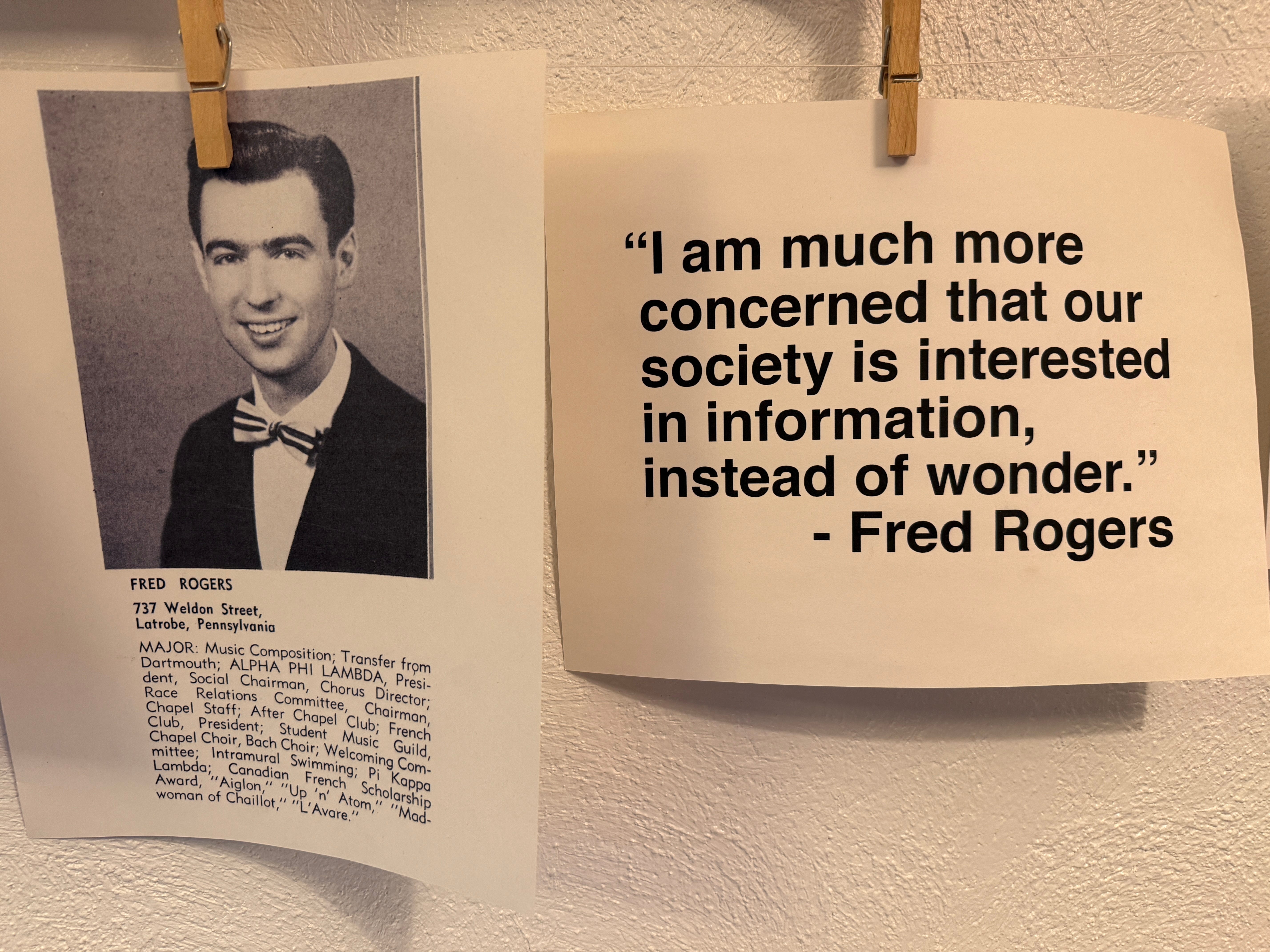
Back in the 1980s I bought a book about my favorite band, The Cure. Information was so rare back then — to have the stories, interviews, and photos in that book opened up a whole world to me. Today, we have instant access to information about everything. And that can be overwhelming. It reminds me of this quote from Fred Rogers I have hanging here on the wall of my studio:
Find Joy in What You Create and How You Share
Psychiatrist Jeff ended his video with an interesting observation:
“A lot of what we lost that made daily life more human wasn’t outdated. It was just in the way of someone’s business model.”
It’s easy to hear that and feel jaded. But I try to take the opposite view: this is an opportunity to forge a path that works for me. I want to share a few examples of that which have been inspiring to me.
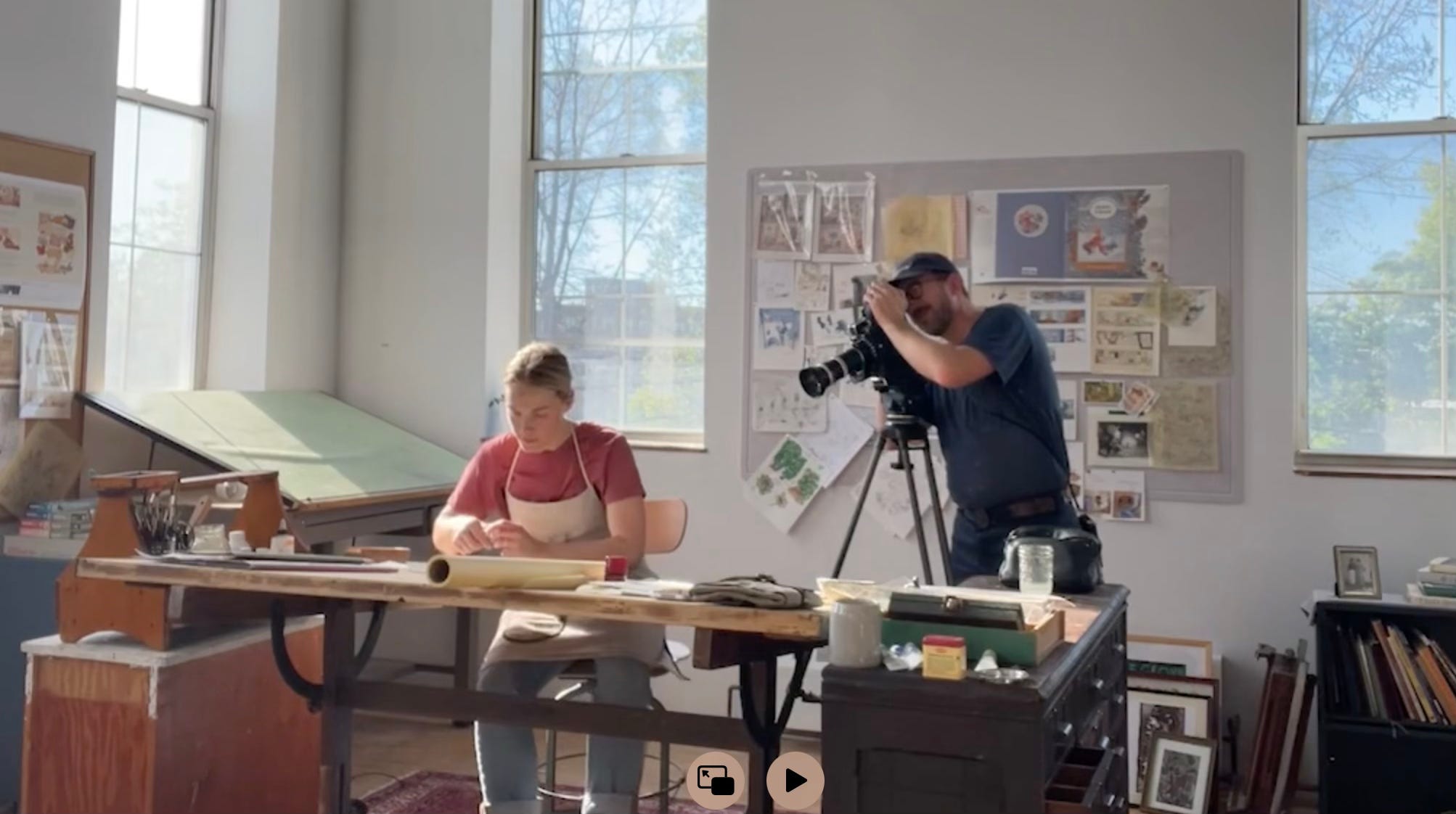
Last week I mentioned author and illustrator Rebecca Green, and how she is preparing for the launch of her new series, Henri & Miko. She shared a brief video on Instagram, teasing how she is preparing the book trailer for it. But on her Patreon, she shared a longer 35 minute video about book trailers and her process, that is part one of a two part series. It was incredible to watch this, and well worth the $5 per month just for this one video.
As she talked about the history of book trailers, her own experiences with them, and how she is producing the trailer for her new series, she focused on the concepts of FUN and CRAFT. She didn’t feel she needed to have every answer, and clear return on investment, justifying:
“I don’t know if it will sell books, but in today’s age, video is king/queen. So having any sort of video presence is great for a book. Video is necessary for sharing these days.”
That was enough for her. How did she approach the process? With community and craft. She hired a friend of hers to film it on… actual film!
In the video, she speaks directly to the viewer:
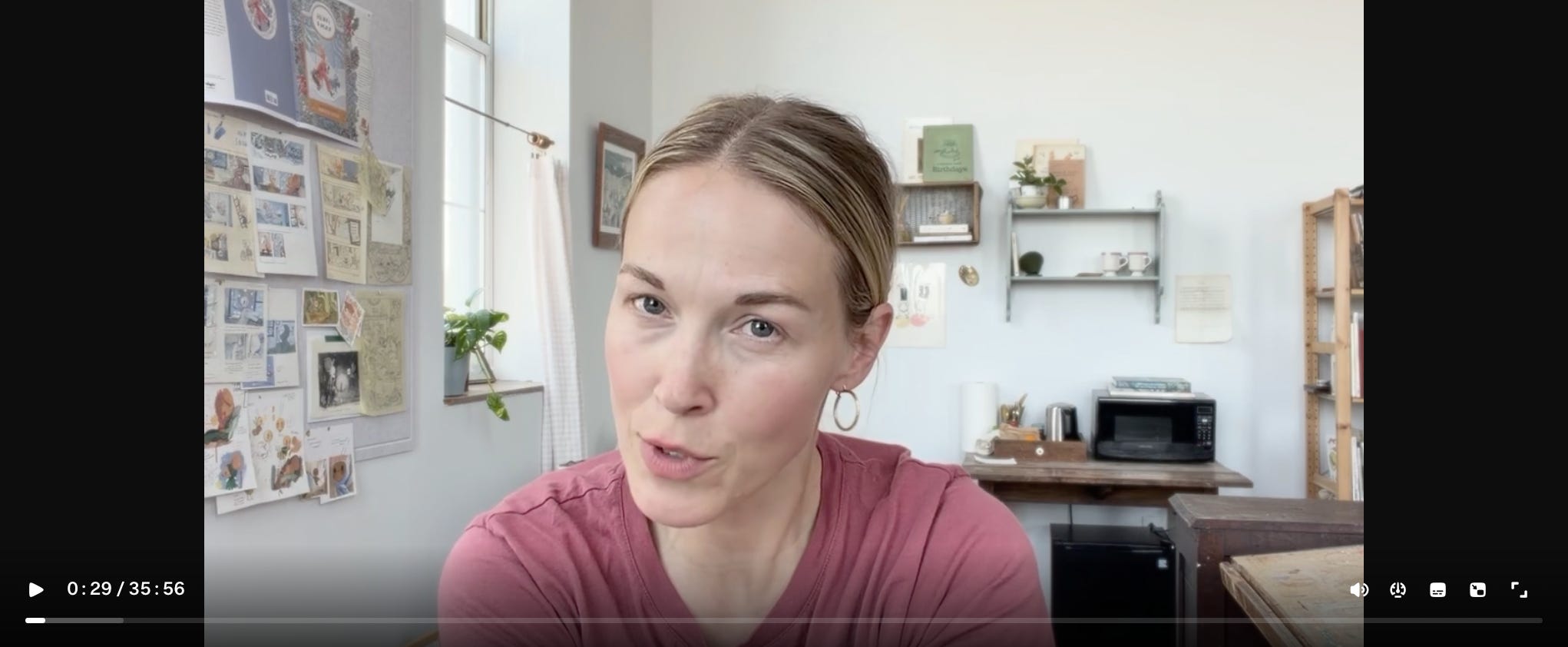
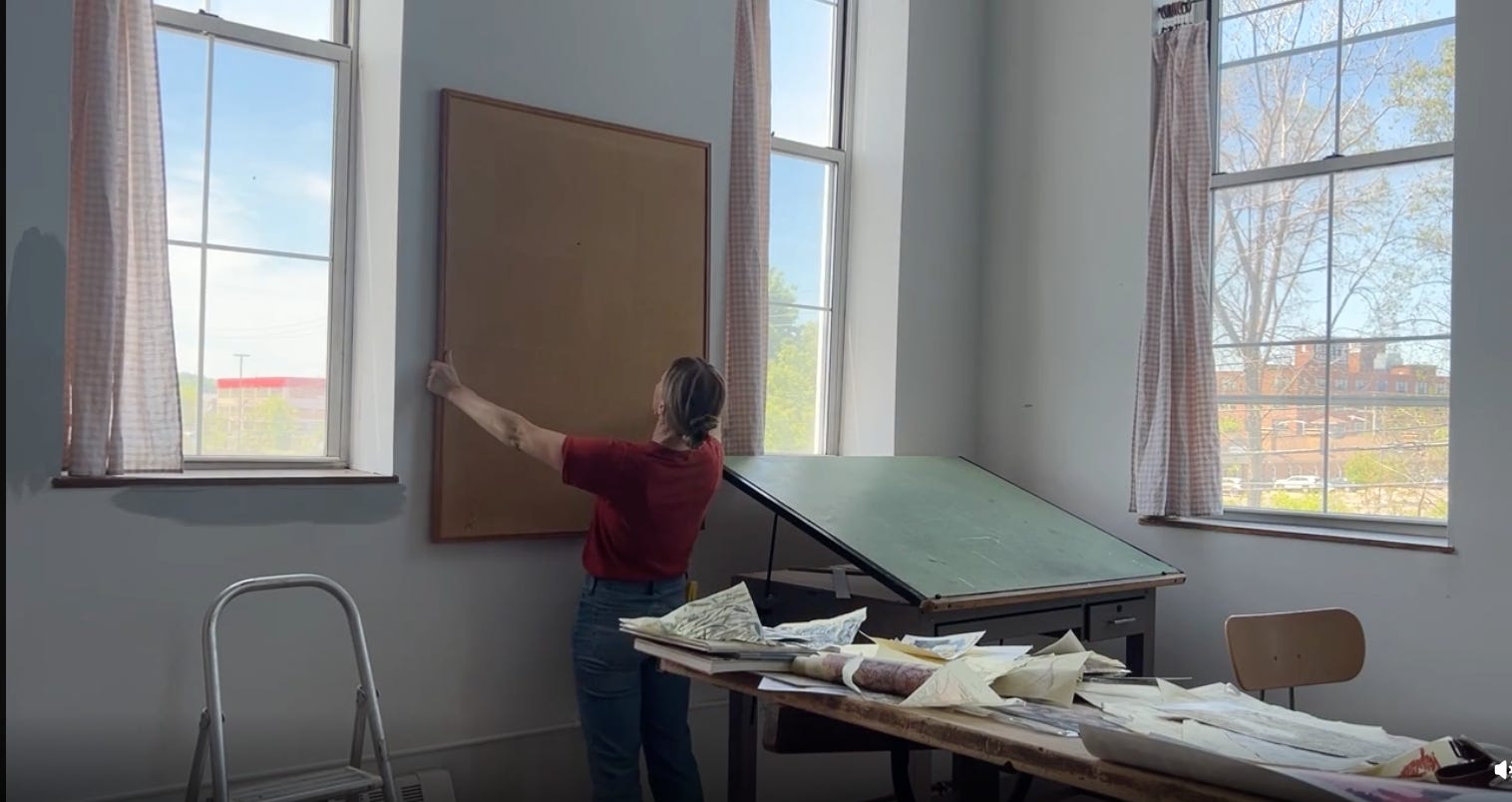
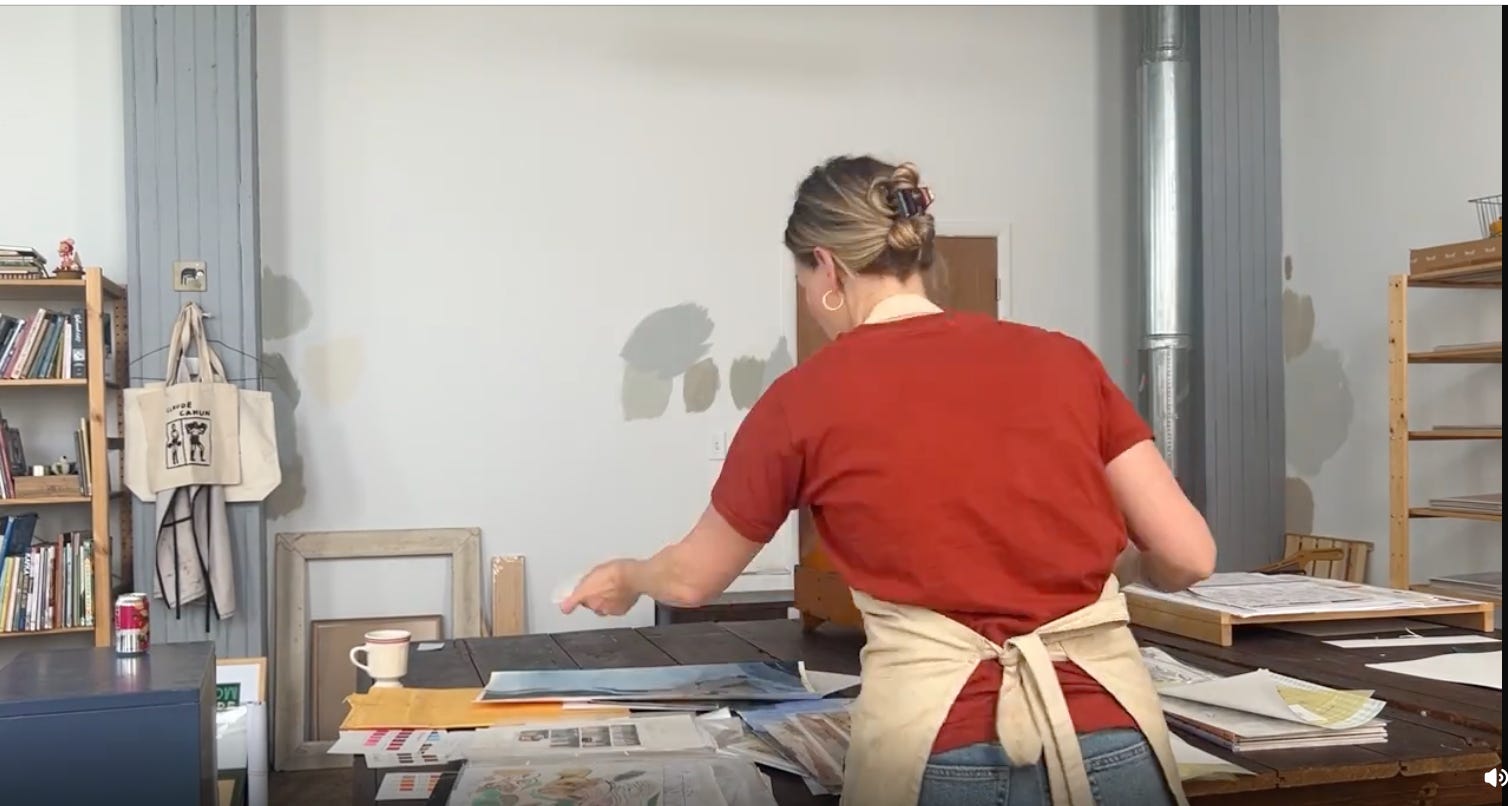
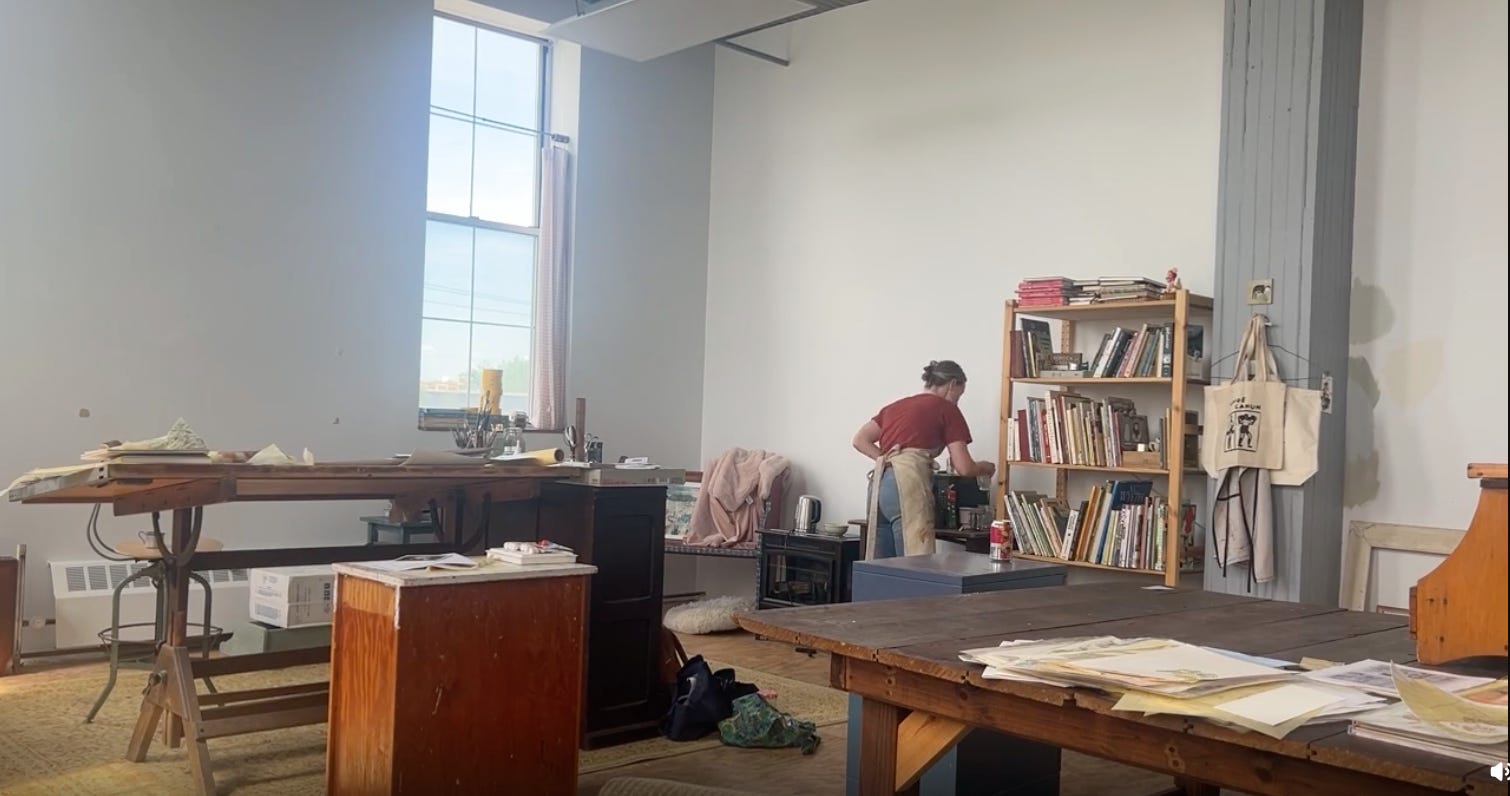
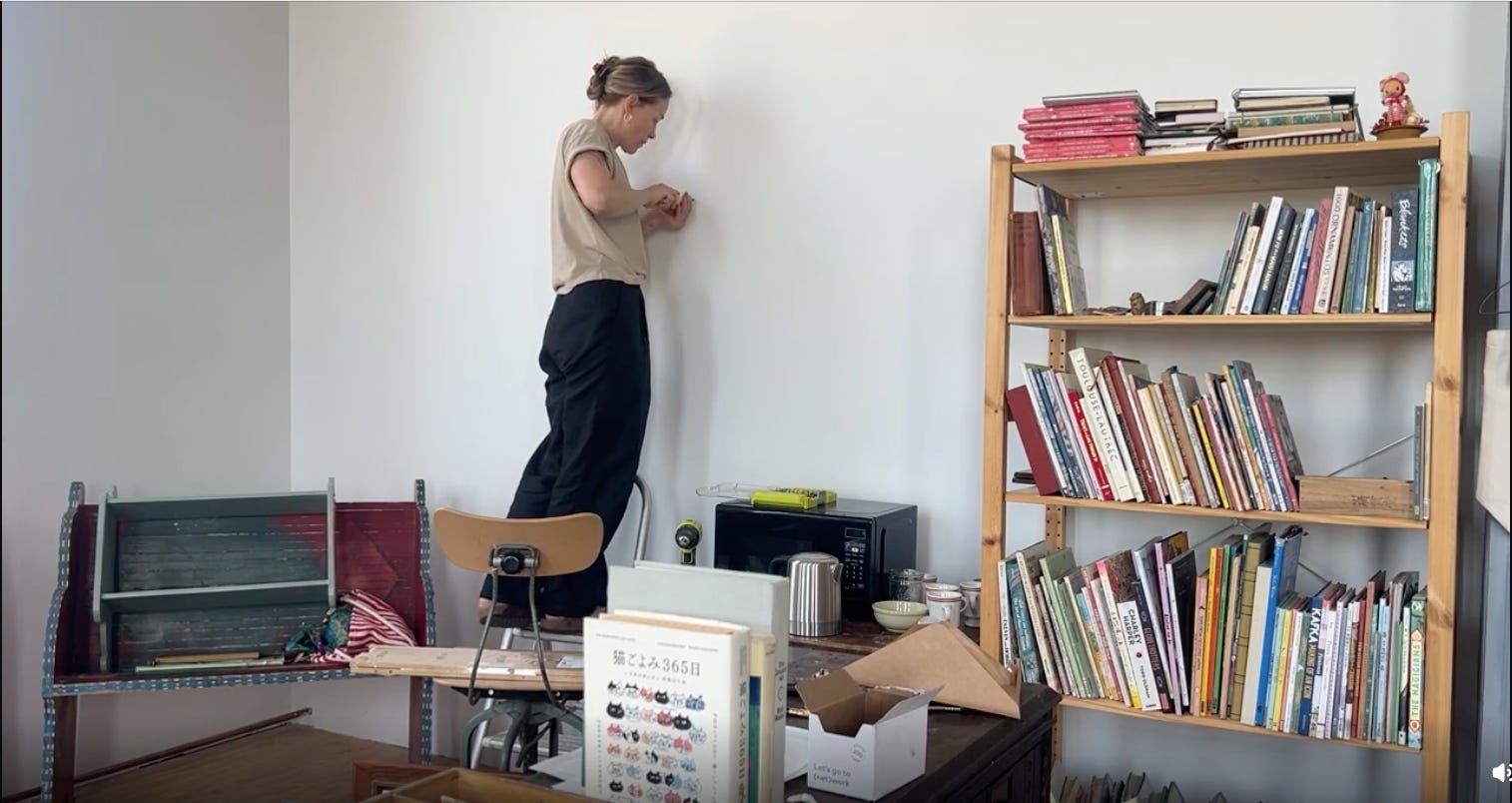
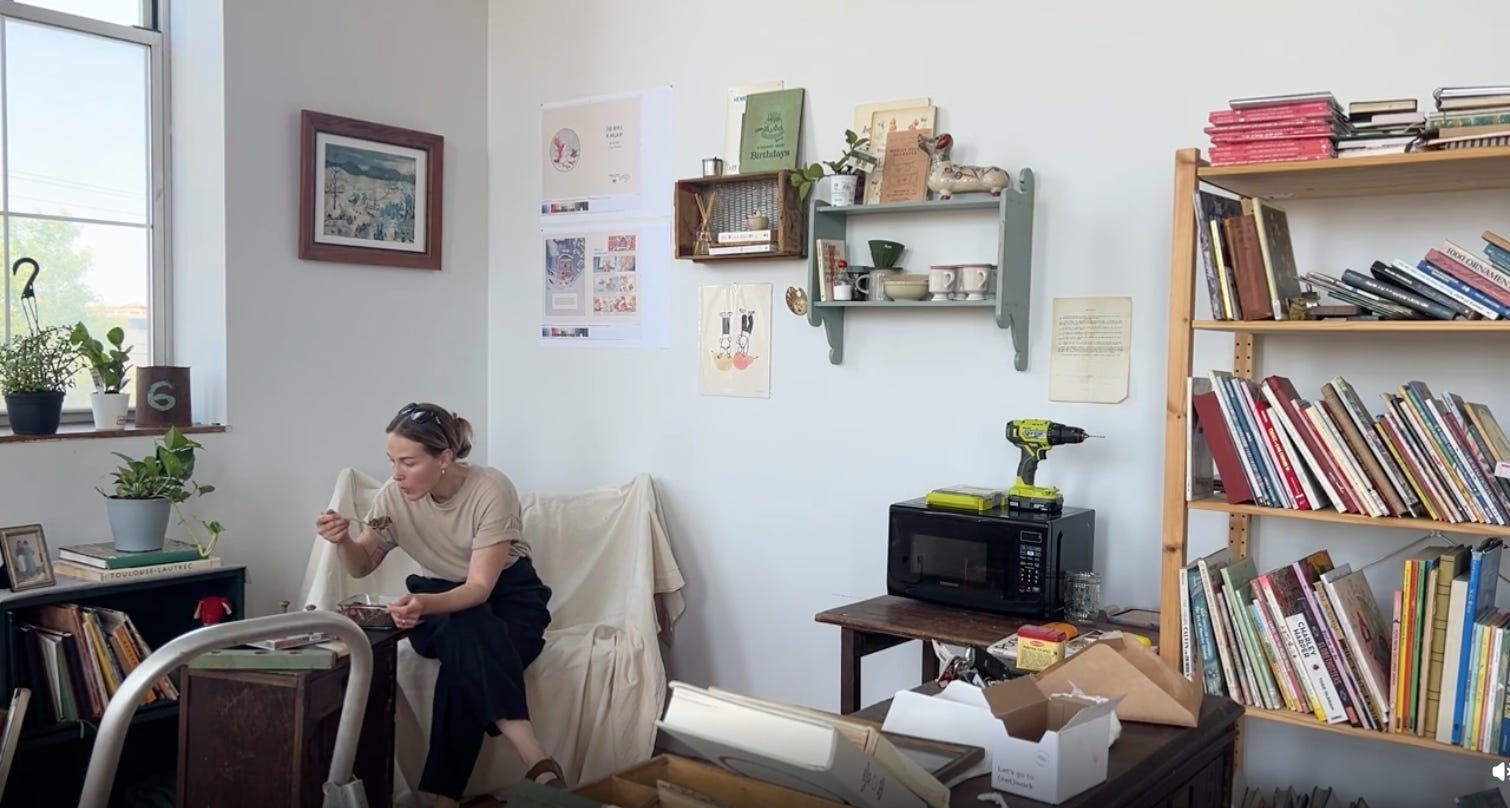
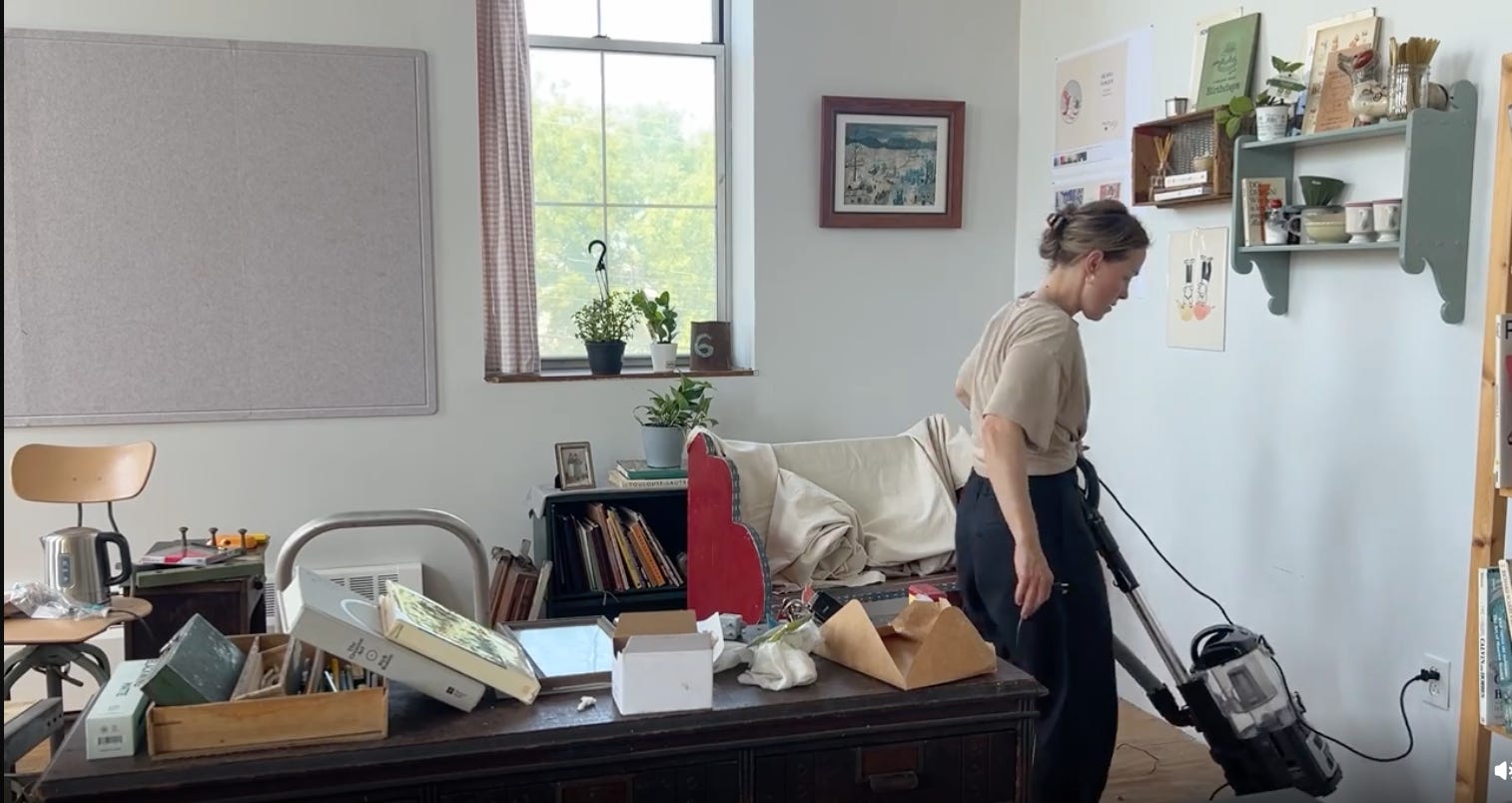
Then explains the various aspects of how she approaches book trailers. For her new one, what was a critical step for creating her book trailer? Cleaning, organizing, and redesigning her studio. She’s said this took 2 to 3 days, a real commitment amidst her otherwise busy schedule and responsibilities. Yet, this was part of the craft of her work. Ten minutes of her video is a montage of her doing exactly this. I loooooooove how she included this. As a creator, we often work alone. It can feel isolating to spend two days organizing one’s creative space, and maybe even difficult to justify. But that is the work, and I so appreciate that she was so open about it:
I highly recommend you subscribe to her Patreon. There is so much more in just that one 35 minute video that dives deep into how she approaches sharing and marketing around book trailers, and her entire creative world. Plus, she has 200 other posts available, most of them videos, I believe.
Her book trailer won’t be out until later in the summer, and she described how much more complicated shooting on 16mm film was. The camera can only shoot 28 seconds at a time, it doesn’t record audio, and you have to constantly use a light meter to test the exposure for a shot. Filming was a 10-12 hour process for a few days.
This week, I’m also celebrating how other creators I know are putting their work out into the world. Emma Gannon has a new book coming out next week, A Creative Compass. She has made some huge shifts in her own creative world in the past few years, closing down her incredibly successful podcast, putting much of her Substack, The Hyphen by Emma Gannon, behind a paywall, and publishing a wide range of books. It’s been inspiring to see how she and her work have evolved over the years, always with a conscious choice to move in the direction that suits her.
My friend Samantha Dion Baker’s new book came out this week, Color Your World.
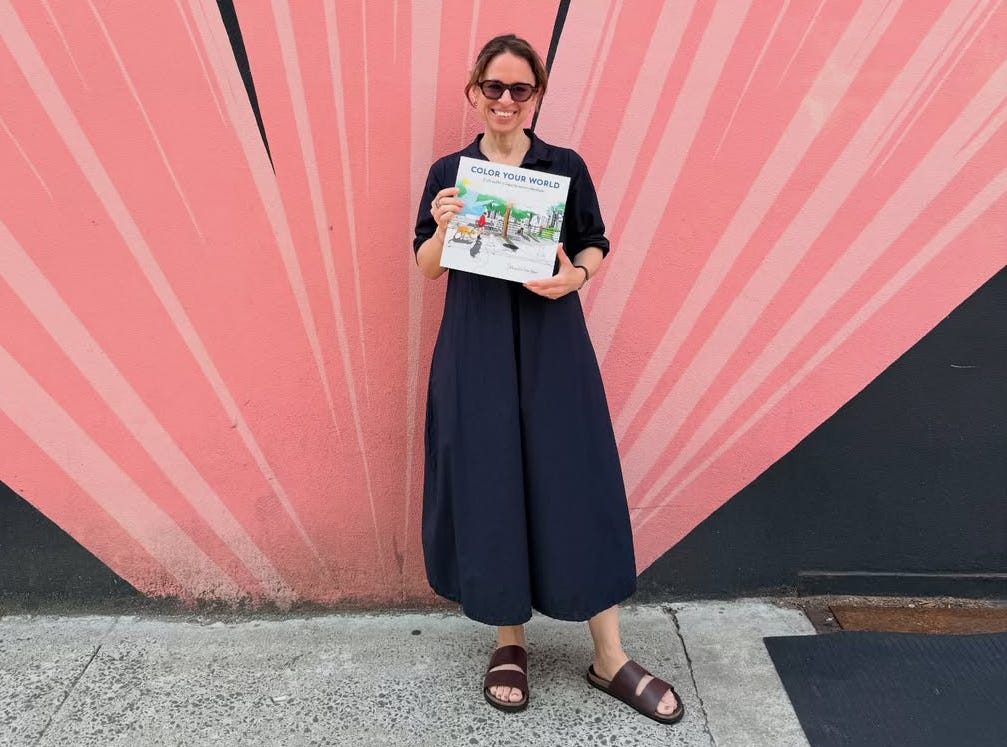
It’s a coloring book, and my 9 year old got to work on it right away:
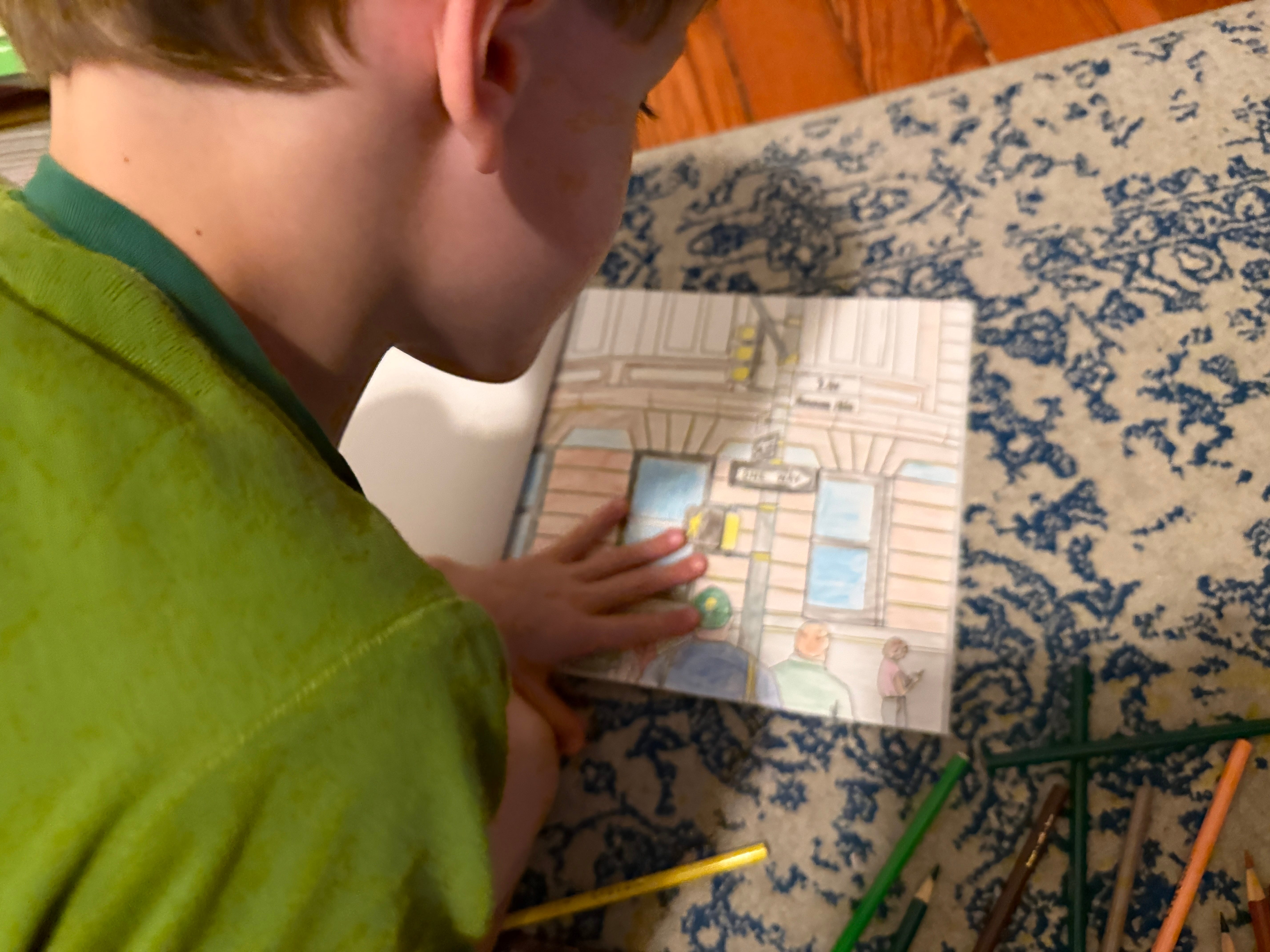
It’s a great reminder that all books are interactive. The reader is engaging with it from their own life experience, their own mindset and goals. They bring themselves to it just as much as the writer does, and together — between the author, reader, and work itself — something magical happens.
Get Off the Treadmill That Someone Else Controls
I say this all the time, but it bears repeating:
You have agency to choose the path that is right for you.
You are a creative force.
Speak to the reader, stop worrying about a faceless “audience.”
It is easy to feel overwhelmed nowadays, to feel trapped by things beyond our control. When I consider Psychiatrist Jeff’s insights, and how so many creators are forging a path that is unique to them, I feel a wonderful sense of opportunity. That we each get to choose this for ourselves, and we have so many more options than ever.
If you want to explore working with me, there are two ways I collaborate with writers and creators:
I just opened the doors to my next Creative Shift Mastermind group, which begins on July 6, 2026. Spend three months with me and a small group of writers as we clarify who you are as a writer, what you create, and how to confidently share your work with the readers who will love it. Full information and reserve your spot here.
Recent videos available to my paid Substack subscribers:
You have a creative voice. What will you say? (19 minutes)
Three common mistakes writers make trying to describe their writing (12 minutes)
Navigating the next phase of your creative life: Honoring your journey and charting a new path (12 minutes)
As always, thank you so much for being here with me.
-Dan
Kids of the Week: Working on his next project:
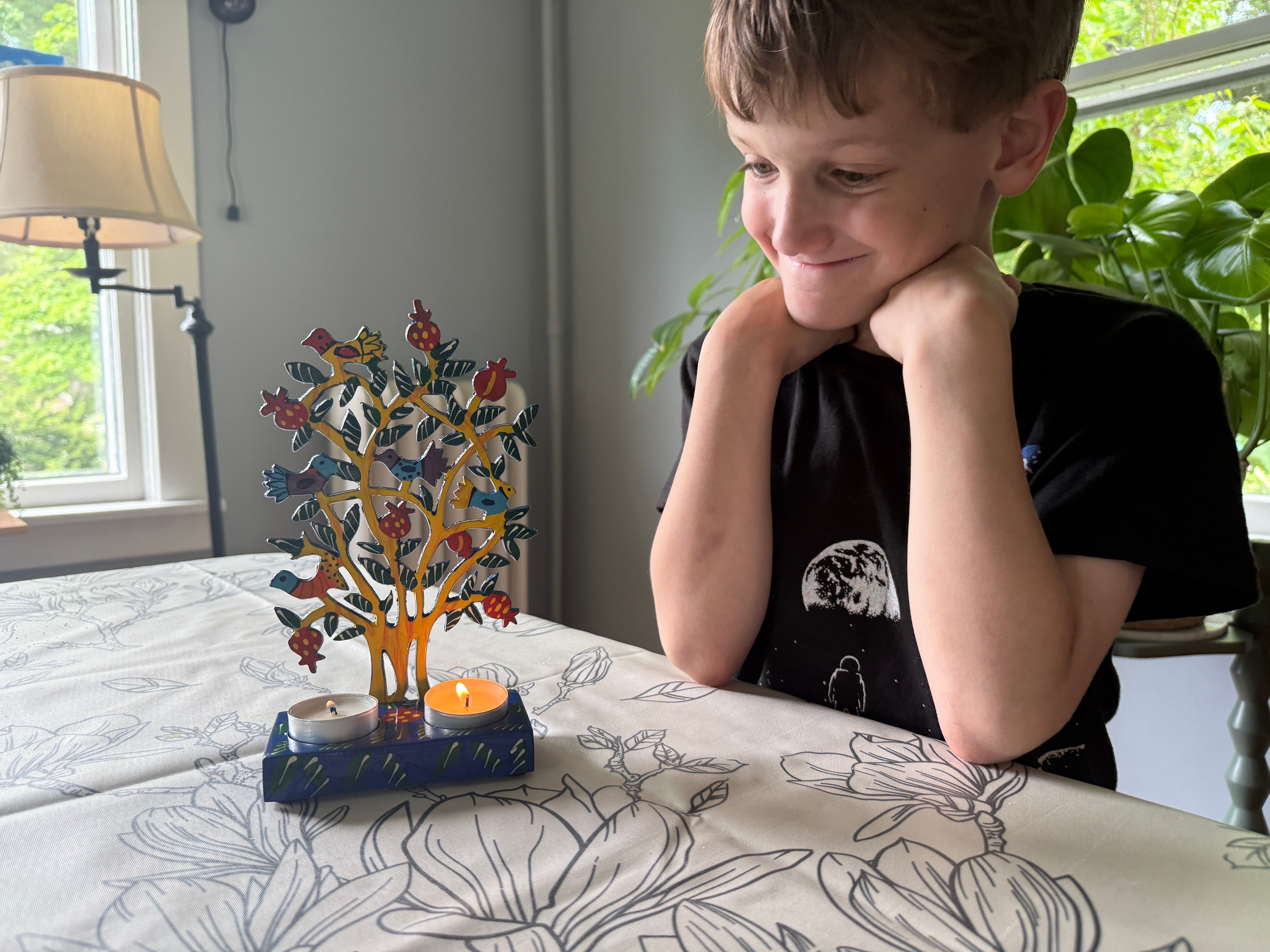
Lighting the Shabbat candles:
“A lot of what we lost that made daily life more human wasn’t outdated. It was just in the way of someone’s business model.” This quote was a Wow moment for me.
What Jeff Knuppel says about our lives today defines for me what I've been merely intuiting lately. Of course, I learned about it on my phone first and then my laptop. Maybe this is why the acronym, IRL, creeps me out?
Your always sweet photos of your son includes one of him lighting the Shabbat candles. I was delighted to see your version of our hanukkiah. They look as if they were made by hand.