
Why we write
And how every reader is a new beginning

Every week, I see new stories of drama and controversy in publishing. Colleagues and friends sharing insightful essays and analysis of them. I see social media posts that explore situations within different niches of publishing, some of which I did not yet know about. Writers I work with tell me about them, and we discuss how it may impact their own aspirations.
This week, there has been so much discussion about how AI is impacting writers and publishing. Several distinct stories came out, and to be sure, each is important. What is happening matters deeply not only to the individuals involved, but may be affecting swathes of authors everywhere.
It’s easy to get twisted up in knots reading about all of this. To have it overtake your time and energy. To make you conclude that things are worse than ever for writers. That there is a grave injustice happening just beneath the surface, and exploring this must occupy all of your time. Or that it may be useless to work on your writing craft at all, because the AI-bots are taking over.
And while I am keeping tabs on everything, I’m also trying to balance it with attending to my craft, and sharing real moments with people I admire. This image I shared on Substack Notes the other day sums it up the idea that there is so much that we do have control over, namely our ability to write, to connect with others, and to channel our attention:
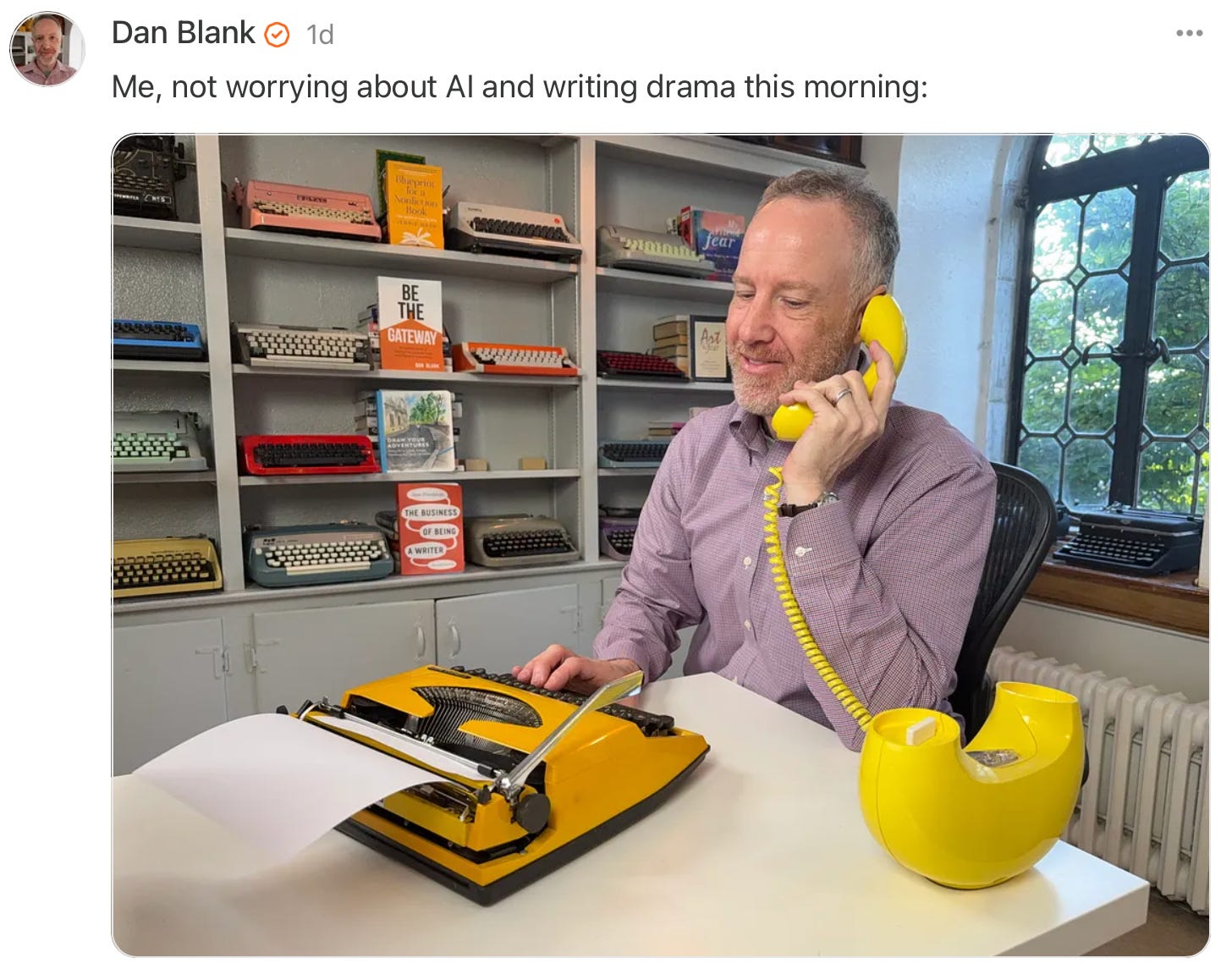
I worry that this comes across as flippant, but that is not my intention. I am so grateful that others are uncovering important issues in publishing. This photo is a reminder for me to focus on craft and connection with others.
I do keep track of everything that is happening. I consider how it may impact writers, and integrate that into those I work with directly.
But I set a boundary as to how much of my energy it takes up. And today I want to talk about why. Let’s dig in…
A Sudden Ending
Just before my kids were born, I became a huge fan of the music of Glen Hansard. You may know him from the movie Once, and the accompanying album that he and Markéta Irglová released as The Swell Season, which they won an Academy Award for.
When they played Radio City Music Hall, I got to the show like 5 hours early to wait by the stage door. Eventually, they came out and we had a lovely conversation:
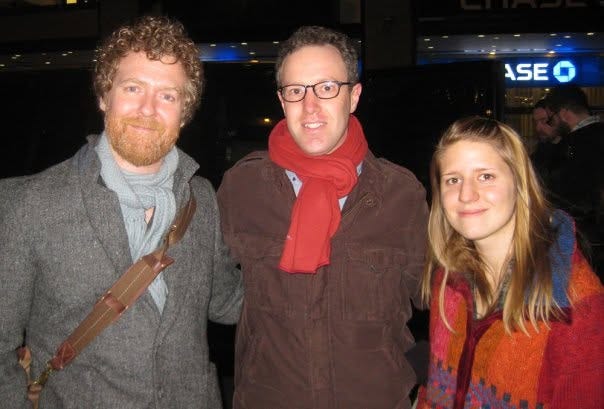
Glen died last week in a motorcycle accident. It seems he lost control of the bike after hitting soft ground along the shoulder of the road. He died on the scene. He was 56 years old. He and his wife have a 3-year old son. This is her moving eulogy and poem at his funeral.
Years ago, when I saw him play a show at a small venue, they unexpectedly sat me in the front row, quite literally underneath Glen. Here is one of the songs I recorded that night:
This is another recording I made at a different show, a celebratory version of the song “Heyday,” which perfectly sums up the message of todays’ essay:
Every Reader is a New Beginning
When I read about publishing news that touches upon important issues which may lead me to distraction, something I consider is this: I will die one day. Hopefully later than sooner. But this life is rare and precious. This moment is special. I want my days to be filled with wonder, connection to those who inspire me, and creativity.
This summer I have been considering some of the core beliefs that drive my work helping writers create and how we share:
You have a unique creative voice.
Sharing is a craft.
You are a creative force.
You have agency in your journey.
Challenge your assumptions.
Ignore best practices.
Speak to one person, not an audience.
No one knows what works, but doing things works.
Glen embodied these in his own unique way. That is special, because it is easy to agree with ideas, but often difficult to live them day in and day out.
His career was built over the course of decades in the music industry, which is notorious for being complicated and difficult. Yet, he forged a path that was uniquely his. He brought people together around music. This is Glen, just a few hours before his death, playing amidst a crowd of people at a pub in Dublin:
These songs live on. Just as your writing lives on.
I think of Kathy Pooler, an author who was a part of many of my past Mastermind sessions. After spending 30+ years as a nurse, she retired in 2011. Then, she wrote memoir, publishing her first book in 2014, and her second in 2019. She died in 2022.
She is no longer with us. Her website seems to be offline. Her social media channels are stagnant. Yet her books are still available to be purchased and read through Amazon. To me, that is incredible.
Kathy’s voice is alive again. It’s just waiting to be discovered. Every reader is a new beginning.
We Sing Into the Future
A year ago, I posted an essay titled, “Here’s where the story ends,” in which I reflected on the passing of my second cousin. We had connected over genealogy research, each fascinated by the historical branches of our family.
In the past two years, that research has helped me uncover members of my family that died in the Holocaust. As I built my family tree, it was astounding to see some branches expand and flourish, and others cut off entirely, ending in the early 1940s. The difference was stark, to see generations lost.
I have to do copious amounts of research for even the tiniest scrap of information about an entire side of a family that had ended. And it’s wild to compare that to branches of the tree that survived and still flourish today, with dozens of people, thousands of photos, and a nearly infinite number of stories, all readily accessible and still growing.
I am reminded again, this time is precious. Our connection to others matters. What we create has meaning.
That post from a year ago ended with a video from Glen, one of my favorite live recordings ever. He sings a trifecta of songs honoring those we love, and those who have passed. The song “Red Chord” is about feeling distant from those we love, and trying to pull them closer. “Heyday” is a song written by Glen’s good friend Mic Christopher who died young in an accident. And “The Parting Glass” is a traditional song, where Glen beautifully describes the necessity to keep singing these songs and telling people’s stories. He says, “In oral tradition, you take the song of those, and you sing them, and you sing them, and you sing them into the future.”
The video is 10 minutes, and it gets more beautiful each minute you watch:
We live in a complicated age. We have so much information not only available to us, but seeking us out every minute of every day. And yes, much of this information is often important.
But I also pause in these moments to remember that we each have the agency to make choices about where we focus our attention, how we use our voice, how we develop our craft, and how we connect to others in ways that are meaningful.
That is the ethos of how I work with writers to help them connect with readers. But it is also how I try to balance the idea of filling my days with wonder, craft, and connection to others that fills my heart.
I simply want to remind you: your creative vision is worth pursuing. Your voice matters.
Enjoy Yourself, It’s Later Than You Think
I often think of the 1949 song, “Enjoy Yourself (It’s Later Than You Think)” — a reminder that life is worth living in the moment.
The other day, I saw an interview that moved me. Actor Bruce Campbell shares how his cancer diagnosis has filled his life with beauty. (Warning: lots of cursing in this clip):
I end every newsletter with this phrase: “Thank you so much for being here with me.” Why? Because I know it is a rare and special thing to be together, even for a moment. I don’t take that for granted. I am alive in this moment, and you are here with me in that moment, and I am truly grateful for it. I am constantly aware that this is all finite, and the fact that we have this moment together is very special.
Thank you for writing and sharing your voice. And thank you for being here with me.
-Dan
If you want to explore working with me, there are two ways I collaborate with writers and creators:
Recent videos available to my paid Substack subscribers:
The work of sharing your writing (14 minutes)
Why we resist sharing our writing (25 minutes)
Sharing what is real in an age of AI-perfection (25 minutes)
Kids of the Week: Practicing a new song he is learning:
I wish I had been able to see Glen Hansard in concert. When my kids were very young, I had tickets to go see him and Markéta in NY after Once made it big, but we had to cancel at the last minute. In my circle of friends (and from what I saw in NY), his death didn't even make a blip, but I was not only shocked to learn of his death, but brought to tears in seeing the live rendition of "Forever Young" at the end of his funeral. His music will live on well past him as will our writing.
Great post. There are now too many posts, meetings, workshops, discussions about A.I. and much of it is redundant, which feels ironic. We're worried about A.I. duplicating and sharing, and yet we writers go to too many workshops, online forums, and so on that all say the same things. We go to workshops about it instead of spending the time creating our own stuff! I now tend to avoid the A.I. discussions because I'm too busy. I agree with you, Dan. Let's focus on the value each of us is putting into the world with our original work and how we share that. I heard a statistic last night at a workshop for children's writing that said the Department of English is getting the second-highest enrollments (with data center stuff being first) at University of Wisconsin-Madison. I have not verified that stat, however it came from a credible source. Writing and understanding good writing is lauded. I like that! And I like your attitude. Let's keep writing!